
The Benazir Income Support Programme (BISP) is more than just a government initiative it’s a vital lifeline. But for years, accessing these funds often meant long lines, confusing paperwork, and reliance on third-party agents who didn’t always have the beneficiaries’ best interests at heart. As we move into February 2026, the landscape of social welfare has shifted dramatically toward digital empowerment.
The BISP 8171 Web Portal has evolved into a robust, primary gateway for verifying financial assistance. It eliminates the need for physical visits for simple status checks, offering a transparent window into eligibility and payment schedules. Whether you are a long-time beneficiary or a new applicant hoping to join the Kafaalat program, understanding how to navigate this digital tool is essential.
This guide provides a comprehensive look at the 8171 system as of early 2026. We will walk you through the exact steps to check your CNIC status, explain how the backend verification works with NADRA, and troubleshoot common issues that might be holding up your payments. It is time to take control of your financial aid information from the comfort of your home.
What Is the BISP 8171 Web Portal?
The 8171 Web Portal serves as the official digital interface for the Benazir Income Support Programme. While the program itself manages the distribution of cash transfers to deserving families, the portal is the user-facing tool that brings transparency to the process. It allows beneficiaries to confirm immediately whether they qualify for payments and if their latest quarterly installments have been released.
Designed with accessibility in mind, the platform caters to a diverse demographic, including women, elderly citizens, and residents of rural areas who may not have easy access to transport. The interface is simple, requiring minimal data input to generate a clear status report.
Key Services Available in 2026
By February 2026, the portal has been streamlined to offer five critical services:
- CNIC-Based Eligibility Check: A quick search to see if a specific National Identity Card is registered in the system.
- Live Payment Status: Real-time updates on whether funds have been transferred to the beneficiary’s account.
- Installment History: A view of past payments to help track financial support over time.
- Clear Ineligibility Reasons: Unlike older systems that simply said “rejected,” the current portal often provides context, such as NSER survey requirements.
- Upcoming Payment Confirmation: Alerts regarding the next tranche of payments.
How the 8171 System Verifies Your CNIC
When a user enters their 13-digit CNIC into the BISP 8171 Web Portal, they aren’t just querying a simple database. They are triggering a sophisticated, real-time verification process that spans multiple national organizations. This backend integration is what makes the 2026 system so much more reliable than its predecessors.
The moment you click submit, the 8171 system communicates directly with the National Database and Registration Authority (NADRA). It confirms that the CNIC is valid, active, and belongs to a living citizen. Simultaneously, it cross-references the ID with the National Socio-Economic Registry (NSER). The NSER is the poverty scorecard that determines a family’s welfare score (PMT score).
This automated “handshake” between databases serves a dual purpose. First, it ensures that funds are strictly reserved for deserving families who meet the poverty criteria. Second, it drastically reduces fraud by flagging duplicate entries or invalid IDs instantly. This digital rigor ensures that the financial aid reaches the people who need it most, without leakage or administrative error.
Step-by-Step: Checking Payment and Status Online
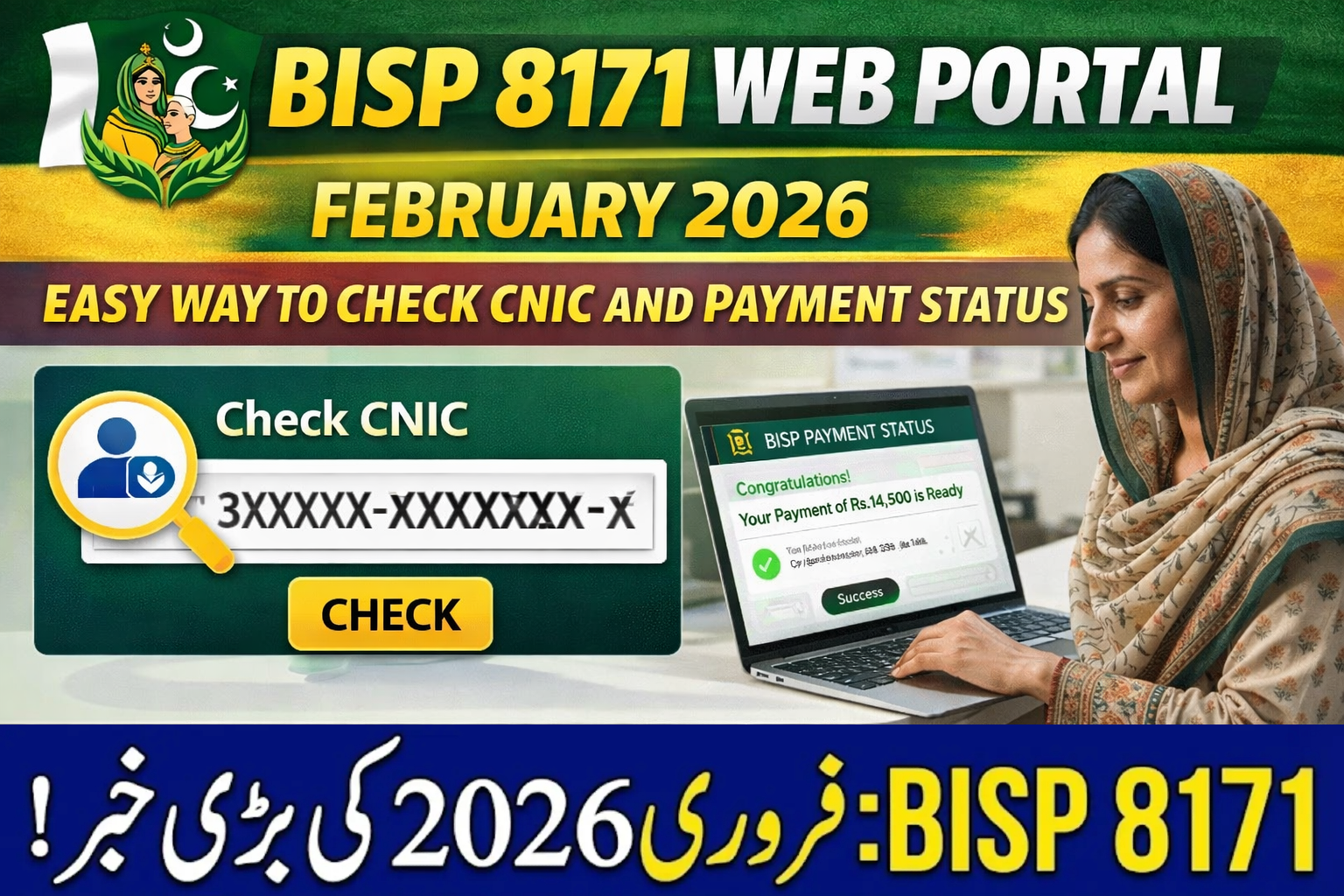
Checking your status is a straightforward process that typically takes less than sixty seconds. You do not need a login ID or a password just your identity card number.
The Verification Method (February 2026)
- Access the Portal: Open the official BISP 8171 Web Portal on any internet-enabled browser (mobile or desktop).
- Input Identification: Enter your 13-digit Computerized National Identity Card (CNIC) number in the designated field. Crucial: Do not enter any dashes or spaces. Just the numbers.
- Security Check: You will see a captcha code (a small image with numbers or letters). Enter this code exactly as shown to prove you are not a bot.
- Submit: Click the green button to verify.
Interpreting Your Results
Once the page loads, you will see one of several status updates:
- Eligible / Payment Released: This confirms you are part of the program and funds are ready for collection.
- Pending: You are in the system, but the specific installment for this quarter hasn’t been disbursed yet.
- Not Eligible: Your poverty score (PMT) likely exceeds the current threshold for assistance.
- Record Not Found: Your data needs to be updated, or you have not yet been surveyed.
This method is currently the safest way to verify payments. It protects beneficiaries from misinformation spread by unauthorized agents who might demand fees for “checking” a status that is free for everyone.
Requirements for Using the Portal
While the system is user-friendly, there are specific prerequisites to ensure accurate results. The portal does not require you to upload scanned documents or photos, but your official records must be in order.
You must possess a valid, unexpired CNIC issued by NADRA. If your card has expired, the system may flag your account, preventing payment release even if you are eligible. Additionally, your biometric data (fingerprints) must be updated in the national database. Since BISP payments are often disbursed via biometric verification at ATMs or campsites, mismatched fingerprints can cause the portal to show errors or hold payments.
Finally, while you don’t need a high-speed connection, you do need a device with a stable internet connection. This could be a smartphone, a tablet, or a computer at a local internet café.
Why CNIC Updates Matter for BISP 8171
A common frustration for many applicants is seeing a “Not Eligible” or “Block” status despite their financial need. Often, this is not a rejection of their poverty status, but a data mismatch issue. The 8171 system relies entirely on the data provided by NADRA.
If a beneficiary marries, divorces, or becomes a widow, their marital status on their CNIC must reflect this change. For instance, the BISP Kafaalat program is largely targeted at married women. If a woman is married but her CNIC still lists her as single, the system may automatically filter her out. Similarly, expired cards are treated as invalid IDs.
Updating your records at a NADRA center is frequently the “fix” for portal errors. Once the biometric and personal details are refreshed in the central database, the 8171 portal usually updates the status within a few weeks, allowing legitimate beneficiaries to rejoin the program.
Physical Support: When Online Isn’t Enough
Digital tools are powerful, but they aren’t perfect. There are times when the portal might show a status that doesn’t seem right, or when a beneficiary cannot access the internet. In February 2026, BISP maintains a hybrid support system to ensure no one is left behind.
If the portal indicates an issue that you cannot resolve online, you have three primary physical touchpoints:
- BISP Tehsil Offices: These are the local headquarters for welfare management. Visit these offices if your survey data is missing or if you need to file a formal complaint regarding your NSER score.
- NADRA Centers: As mentioned, this is the place to go for any identity-related errors, fingerprint updates, or card renewals.
- Partner Banks: If the portal says “Payment Released” but you cannot withdraw the cash, the issue lies with the banking channel. Authorized bank branches or payment campsites can help resolve transaction failures.
Troubleshooting Common Portal Issues
Even with a streamlined system, technical glitches or user errors can happen. Here is how to solve the most common problems users face in early 2026.
Problem: Invalid CNIC Error
This is the most frequent error. It usually happens because the user included dashes (e.g., 12345-1234567-1) or added a space at the end of the number.
Solution: clear the field and type the 13 digits continuously. If the error persists, check your card’s expiry date.
Problem: Payment Status Not Visible
Sometimes, the portal is undergoing maintenance, or the quarterly batch of payments is currently being uploaded.
Solution: Wait 24 to 48 hours and try again. Payment data is often updated in batches, so your record might be in the next queue.
Problem: “Not Eligible” Message
This indicates your PMT poverty score is too high according to the NSER survey.
Solution: If you believe your financial situation has worsened significantly, visit a BISP Tehsil office to request a dynamic registry update (re-survey).
Problem: Captcha Not Loading
Slow internet or browser cache can prevent the security image from appearing.
Solution: Refresh the page or try opening the portal in a different browser (like Chrome or Edge).
Securing Your Financial Future
The digitization of the Benazir Income Support Programme represents a massive leap forward in social protection for Pakistan. By offering a direct line of sight into payment status and eligibility, the 8171 Web Portal empowers beneficiaries to manage their own aid without reliance on middlemen.
As we navigate through 2026, the key to a smooth experience lies in keeping your official documents updated and checking the portal regularly. By understanding how the verification process works, you ensure that you receive the support you are entitled to, exactly when you need it.